You can have traffic.
You can have content.
You can even have a “pretty” funnel.
And still… no booked calls.
This is the silent frustration most coaches, consultants, and service providers deal with every day. They post consistently. They run ads. They send people to a landing page. Yet their calendar stays empty, or worse, filled with unqualified leads who never convert.
The problem isn’t traffic.
The problem isn’t effort.
The problem is funnel design without strategy.
A high-converting funnel that books calls isn’t built by stacking tools together. It’s built by understanding buyer psychology, intent alignment, and conversion systems, and then designing each step to move prospects toward one action: booking a qualified call.
At Trinity Funnels, we see the same pattern repeatedly:
- Funnels built backwards
- Messaging focused on features, not decisions
- No qualification system
- No conversion logic
- No sales handoff clarity
This article will walk you through — step by step — how to design a high converting sales funnel for coaches and service providers that consistently turns traffic into booked calls and paying clients.
Not theory.
Not fluff.
A real conversion framework.
What a “High-Converting Funnel” Actually Means (And What It Doesn’t)
Before we talk tactics, let’s clarify terms.
A high-converting funnel is not:
- A fancy landing page
- A ClickFunnels template
- A long form sales page
- A viral Reel with a link in bio
A high-converting funnel is a decision-making system.
Its job is to:
- Attract the right traffic
- Frame the problem correctly
- Build trust quickly
- Pre-qualify prospects
- Remove friction
- Move the right people to book a call
Conversion isn’t about persuasion.
It’s about clarity and alignment.
If your funnel is doing its job, the prospect should feel like:
“This makes sense. This is for me. The next step is obvious.”
That’s conversion.
The Core Funnel Philosophy: Strategy Before Design
This is where most funnels fail.
People start with:
- Page builders
- Colors
- Fonts
- Copy snippets
- Competitor screenshots
But design does not create conversions.
Strategy does.
Every funnel that books calls consistently answers four core questions:
- Who is this for?
- What exact problem are they aware of right now?
- What belief must change before they book a call?
- What action feels safest and most logical next?
If you don’t answer these first, no design will save you.
At Trinity Funnels, we never design until the strategy is mapped. Because funnels don’t fail technically, they fail psychologically.
The High-Converting Call-Booking Funnel Framework
Let’s break down the exact structure that works for coaches, consultants, and service providers.
This is the same logic used in funnels that:
- Book 5–20+ calls per week
- Pre-sell prospects before the call
- Reduce no-shows
- Increase close rates
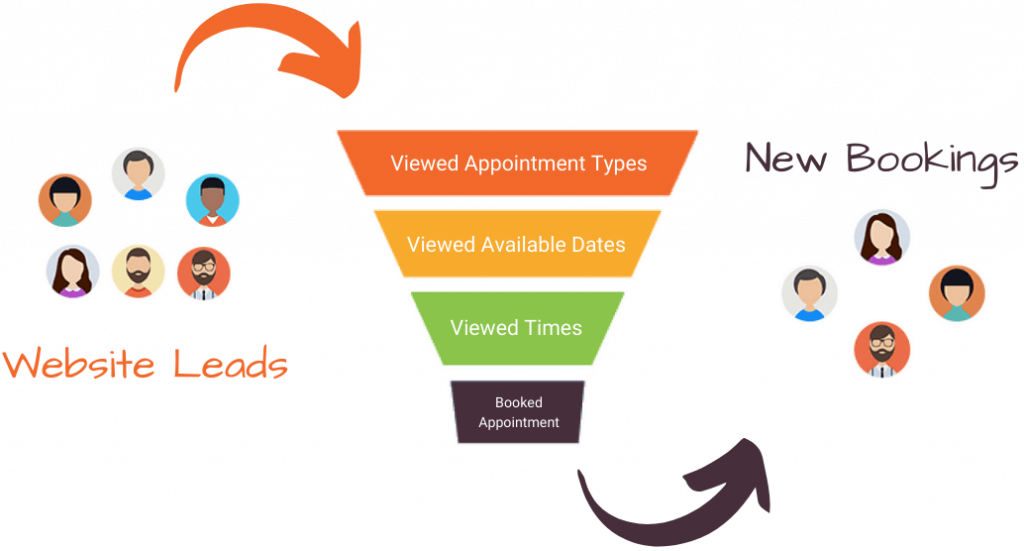
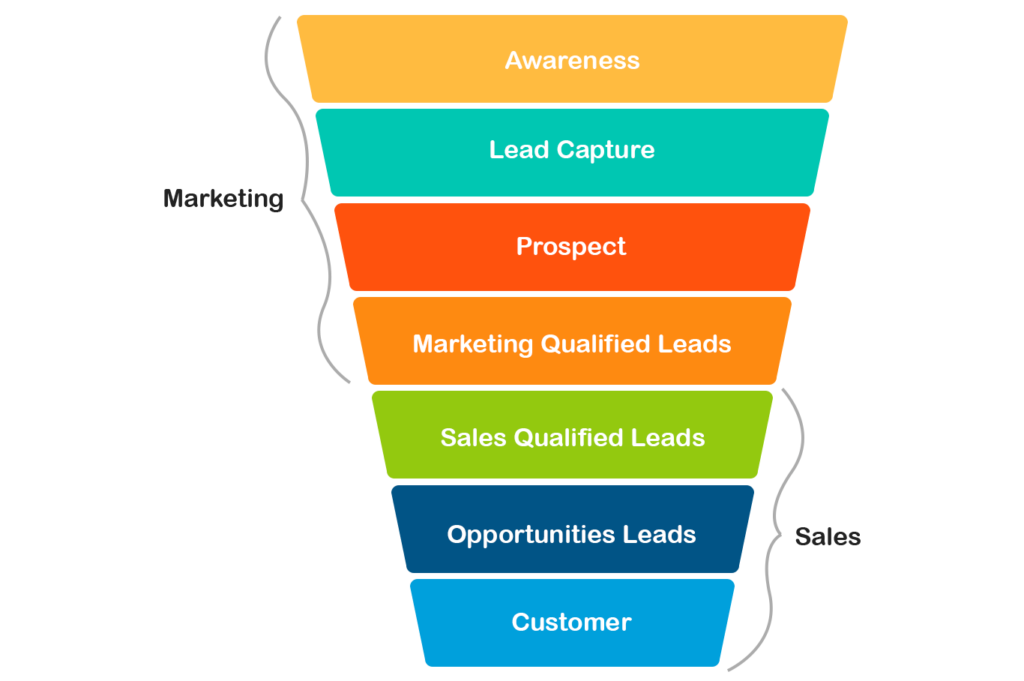
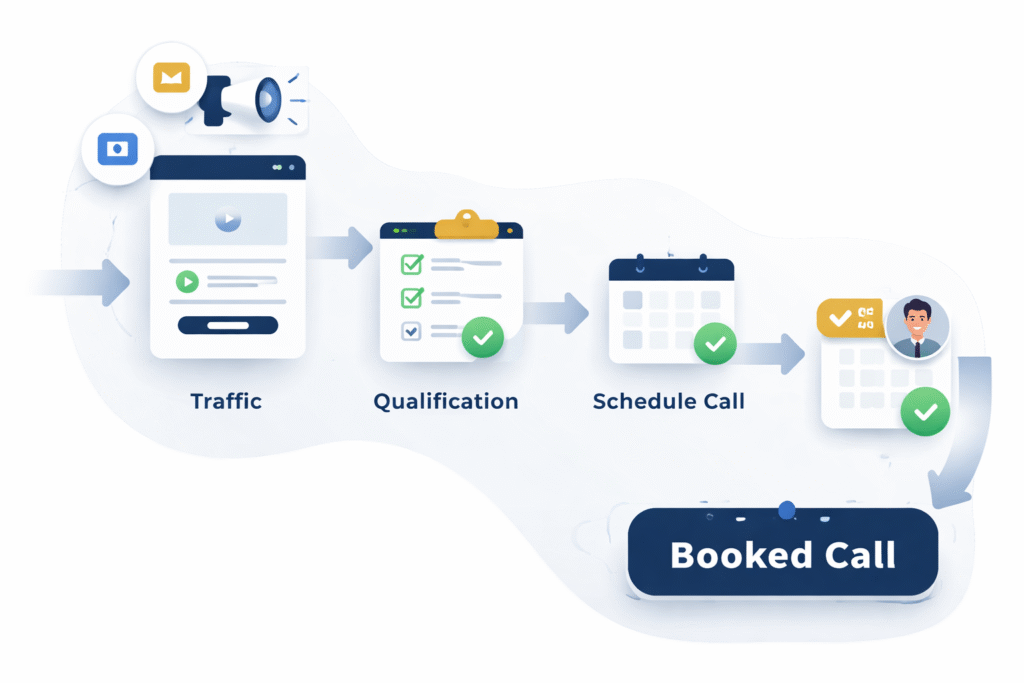
Funnel Overview (At a Glance)
- Traffic Source
- Pre-Sell Landing Page
- Authority & Trust Bridge
- Qualification Step
- Call Booking Page
- Confirmation & Pre-Frame
Each step has one job. Nothing more.
Step 1: Traffic With Intent (Not Just Volume)
Traffic quality matters more than traffic volume.
A funnel designed to book calls should never start with cold, random traffic unless there’s a strong pre-frame.
High-performing traffic sources include:
- Short-form content (Reels, TikTok, Shorts)
- Email lists
- YouTube content
- Warm retargeting ads
- Referral traffic
The key question isn’t:
“How many people can I send?”
It’s:
“How aware are they before they click?”
Best Performing Traffic Mindset
High-converting funnels attract people who are:
- Problem-aware
- Actively seeking a solution
- Already consuming related content
If your traffic doesn’t already believe:
“I need help with this”
Your funnel will struggle.
This is why content-led funnels outperform cold funnels for coaches and consultants.
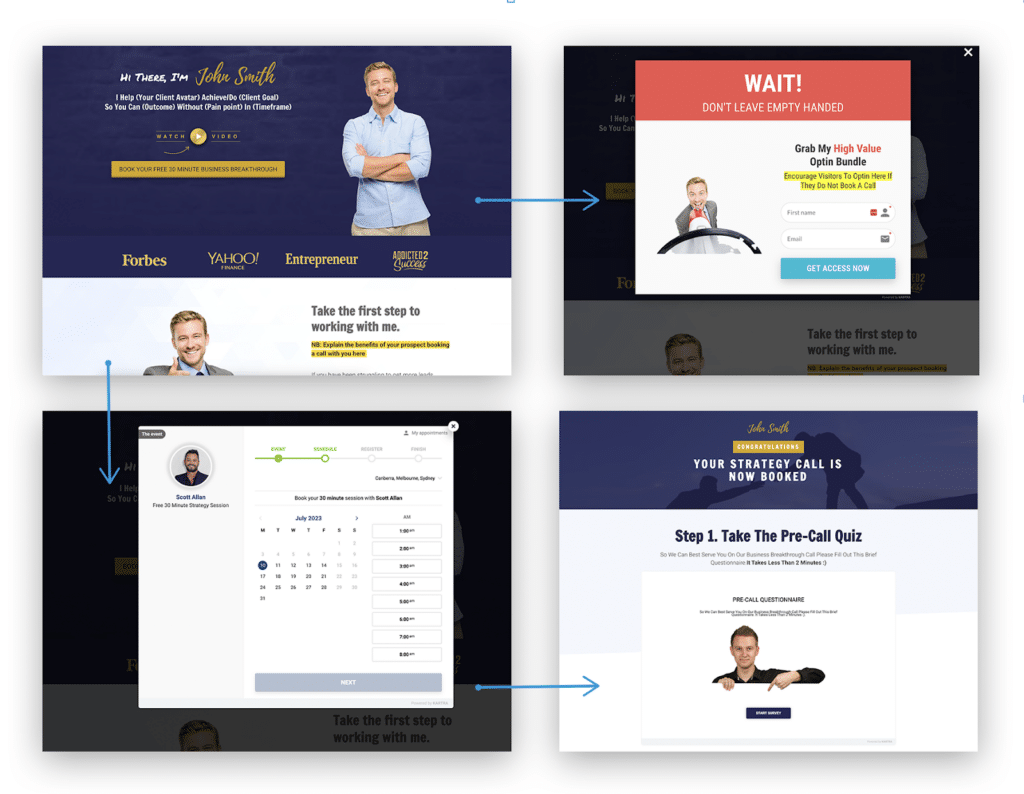
Step 2: The Pre-Sell Landing Page (Your Conversion Gate)
This page determines whether your funnel lives or dies.
Its job is not to sell your offer.
Its job is to sell the call.
A high converting landing page should do three things immediately:
- Call out the exact problem
- Position you as the guide
- Frame the call as the logical next step
Above-the-Fold Essentials
Within the first 5 seconds, your page must answer:
- Who this is for
- What problem it solves
- Why a call is necessary
Example structure:
- Clear, specific headline
- Subheadline that reframes the problem
- One primary CTA (Book a Call)
No distractions.
No menus.
No multiple offers.
One page. One goal.
Step 3: Authority Without Overexplaining
One of the biggest mistakes we see is overloading pages with proof.
Authority doesn’t come from:
- Long bios
- Awards lists
- Generic testimonials
Authority comes from clarity and relevance.
Use:
- Short positioning statements
- Outcome-focused proof
- Simple case snapshots
Your prospect doesn’t need to know everything about you.
They need to know:
“You understand my problem — and you’ve solved it before.”
Step 4: Qualification Is the Conversion Multiplier
If you want better calls, you need better filters.
A qualification step:
- Protects your time
- Increases close rates
- Improves client quality
This can be:
- A short form
- A multi-step application
- Conditional logic questions
The goal is not to exclude everyone, it’s to pre-frame expectations.
Good qualification questions:
- Identify urgency
- Reveal budget readiness
- Clarify goals
- Filter poor-fit leads
This step alone can double your funnel ROI.
What Most Funnels Get Wrong at This Stage
Common mistakes that kill call bookings:
- Asking for too much information too early
- Weak problem framing
- Multiple CTAs on one page
- No qualification
- No trust bridge
- Treating the call like a “chat” instead of a decision
A call is not casual.
It’s a conversion event.
And your funnel must treat it that way.
If you’re reading this and realizing your current funnel:
- Looks good but doesn’t convert
- Gets clicks but no bookings
- Books calls that don’t close
That’s not a traffic problem, it’s a system problem.
Trinity Funnels specializes in strategy-first funnel systems designed to book qualified calls consistently, not just generate leads.
We’ll go deeper into optimization, automation, confirmation pages, and scaling systems in the next section.
Call Booking Pages, Pre-Framing Psychology, and Funnel Optimization That Increases Show-Up & Close Rates
Now that you understand the core structure of a high converting sales funnel for coaches, it’s time to focus on the most underestimated part of the system:
What happens after someone decides to book a call.
Most funnels lose conversions after the click, not before it.
People think:
“If they booked, the job is done.”
In reality, this is where the real conversion work begins.
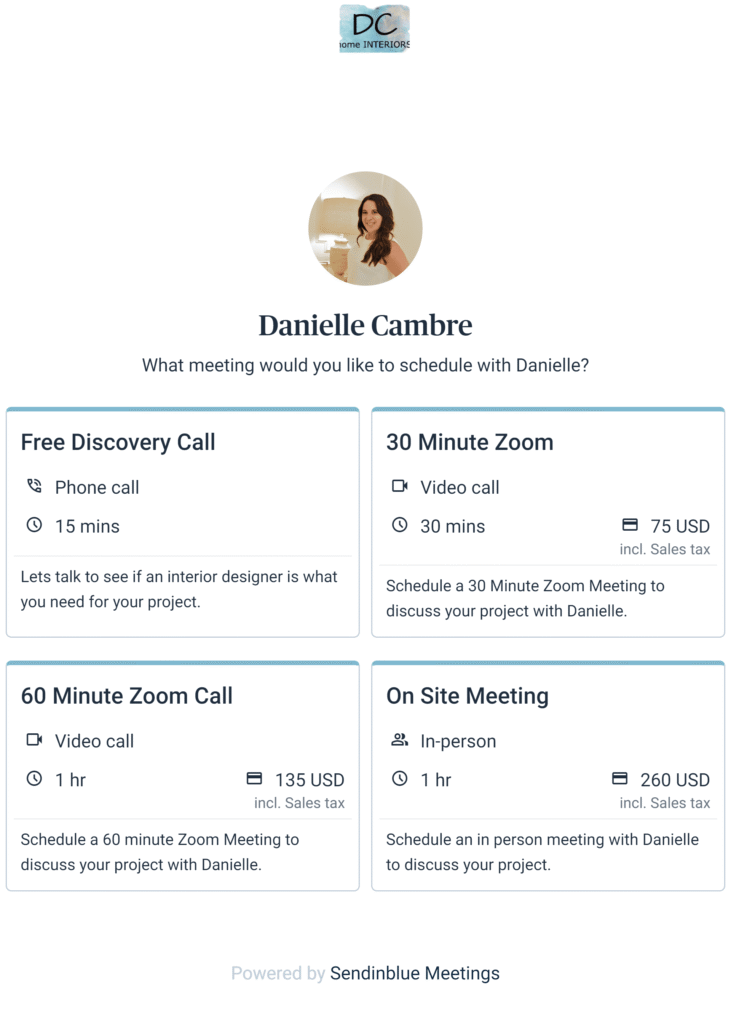
The Call Booking Page: Where Intent Becomes Commitment
Your call booking page is not a calendar embed.
It’s a decision reinforcement page.
Its job is to:
- Confirm they’re making the right choice
- Reduce anxiety
- Set expectations
- Increase show-up rates
- Pre-frame the sales conversation
What a High-Converting Call Booking Page Must Include
A call booking page that actually converts should contain:
- Clear Call Outcome
- What will happen on the call?
- What problem will be addressed?
- What clarity will they leave with?
- Who the Call Is For (and Not For)
- This increases perceived value
- Filters low-intent leads automatically
- Time & Commitment Framing
- Length of call
- Focus and seriousness
- Why showing up matters
- Simple Calendar Experience
- Minimal friction
- No distractions
- One action only
Example Positioning Statement
Instead of:
“Book a free call”
Use:
“Book a 30-minute strategy call to map out a funnel system designed to turn your traffic into booked calls.”
This immediately attracts buyers, not browsers.
Why “Free Calls” Kill Conversion Quality
One of the biggest mistakes coaches and consultants make is undervaluing the call.
When your funnel positions the call as:
- Casual
- Exploratory
- Low-stakes
You attract people who:
- Aren’t ready
- Are price shopping
- Aren’t decision-makers
High-converting funnels don’t sell free calls.
They sell clarity, outcomes, and next steps.
At Trinity Funnels, we design call booking pages to make prospects feel like:
“Not booking this would be a mistake.”
That’s the shift.
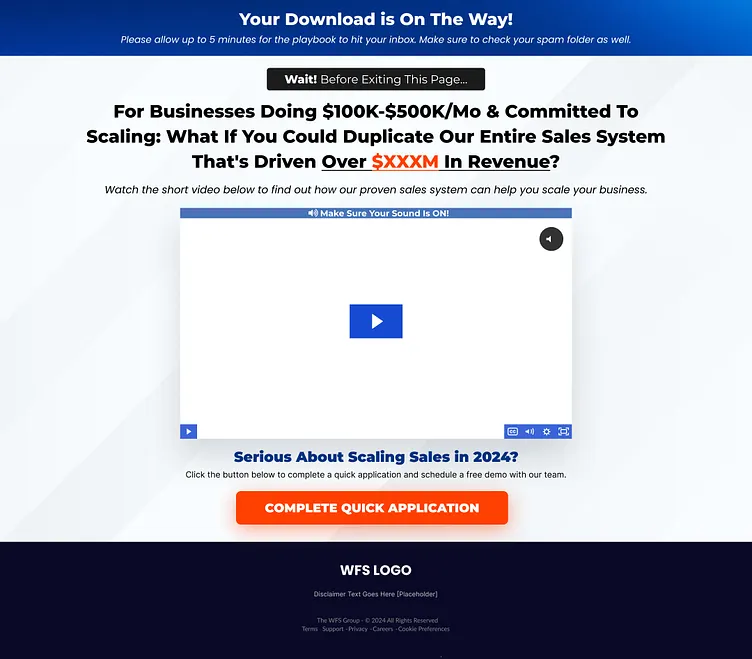
The Confirmation Page: The Most Ignored Conversion Asset
If your confirmation page only says:
“Thanks for booking!”
You are leaving money on the table.
The confirmation page is where:
- Beliefs are solidified
- Expectations are set
- No-shows are prevented
- Sales resistance is lowered
What a High-Converting Confirmation Page Does
A properly built confirmation page should:
- Reinforce why they booked
- Remind them of the problem
- Position the call as a solution checkpoint
- Pre-frame pricing and seriousness
- Introduce your authority naturally
Key Elements to Include
- Short welcome video
- What to prepare before the call
- Who you typically help
- Who you don’t help
- What happens after the call
This page alone can:
- Reduce no-shows by 30–50%
- Increase close rates dramatically
Pre-Framing: The Psychology That Wins Before the Call
Pre-framing means shaping expectations before the conversation.
When prospects arrive on a call without pre-framing, they:
- Ask surface-level questions
- Push back on price
- “Need to think about it”
When pre-framed correctly, they:
- Ask outcome-based questions
- Understand the value
- Are already mentally invested
How Pre-Framing Works Inside the Funnel
Pre-framing happens through:
- Page copy
- Videos
- Confirmation messaging
- Emails or SMS reminders
You are guiding them from:
“Should I do this?”
to
“How do I make this work?”
That shift is where deals close.
Automation Systems That Support Conversion (Not Just Convenience)
A high-converting funnel is not manual.
Automation is not about being lazy, it’s about consistency and follow-through.
Essential Funnel Automations
- Booking Confirmation Email
- Reinforces decision
- Restates value
- Reminder Sequences
- 24 hours before
- 1 hour before
- Pre-Call Assets
- Short videos
- Case examples
- Expectations
- No-Show Recovery
- Rebooking logic
- Follow-up messaging
Each automation increases ROI without adding workload.
This is where funnels become scalable systems, not just pages.
Optimization: Turning a “Working” Funnel Into a High-Converting One
Most funnels don’t need rebuilding.
They need optimization.
High-Impact Optimization Areas
- Headline clarity
- CTA specificity
- Qualification logic
- Call framing language
- Confirmation page messaging
Small changes here often lead to:
- Higher booking rates
- Better call quality
- Shorter sales cycles
Optimization is not guessing, it’s strategic refinement.
Real-World Funnel Scenario (Hypothetical Example)
Client Type: Business Coach
Problem: Getting calls but low close rates
Before Optimization:
- Generic “Free Discovery Call”
- No qualification
- No confirmation page
- High no-show rate
After Funnel Optimization:
- Strategy-focused call positioning
- Qualification questions added
- Authority-based confirmation page
- Pre-framed expectations
Result:
- Fewer calls
- Higher-quality prospects
- Higher close rate
- More revenue with less time
That’s funnel leverage.
Common Funnel Misconceptions That Hurt Conversions
Let’s clear these up:
- ❌ “More pages = higher conversion”
- ❌ “Design sells”
- ❌ “Traffic fixes funnel problems”
- ❌ “Calls should feel casual”
Truth:
- Clear systems convert
- Strategy beats aesthetics
- Quality traffic needs proper framing
- Calls are decision points
Getting started…
If your funnel currently:
- Books calls inconsistently
- Attracts the wrong prospects
- Feels unpredictable
You don’t need more content or ads.
You need a conversion system.
Trinity Funnels builds strategy-first, ROI-driven funnels that turn attention into booked calls, without relying on guesswork.
Scaling, SEO-Driven Funnel Traffic, FAQs, and the Trinity Funnels Conversion System
At this stage, your funnel is structured, optimized, and booking calls.
Now the question becomes:
How do you scale this system predictably without breaking conversions?
This is where most coaches and consultants plateau, not because their offer isn’t good, but because their funnel isn’t built to scale.
Let’s fix that.
How to Scale a High-Converting Funnel Without Killing Conversion Rates
Scaling a funnel isn’t about “adding more traffic.”
It’s about ensuring every part of the system can handle volume.
If you scale traffic without:
- Proper qualification
- Pre-framing
- Automation
- Sales alignment
You don’t get growth, you get chaos.
The Three Pillars of Funnel Scalability
A funnel that scales profitably rests on three pillars:
- Message Consistency
- System Automation
- Sales Alignment
Miss one, and conversion rates drop.
Pillar 1: Message Consistency Across All Touchpoints
Your funnel doesn’t start on the landing page.
It starts with:
- Your content
- Your ads
- Your positioning
If your traffic promise doesn’t match your funnel message, trust breaks instantly.
High-Scaling Funnel Messaging Checklist
- Content speaks to one core problem
- Landing page continues the same narrative
- Call booking page reinforces the same outcome
- Confirmation page deepens belief
No disconnect.
No confusion.
Just momentum.
This is why strategy-first funnels outperform templated funnels every time.
Pillar 2: Automation That Protects Time and Conversion Quality
As volume increases, manual handling becomes impossible.
High-performing funnels rely on:
- Automated reminders
- Smart qualification logic
- CRM tagging
- Follow-up sequences
This doesn’t remove the human element, it supports it.
When automation is done right:
- No-shows drop
- Lead quality increases
- Sales conversations improve
At Trinity Funnels, we build funnels with automation baked into the strategy, not bolted on later.
Pillar 3: Funnel-to-Sales Alignment (The Missing Link)
Your funnel and your sales call must speak the same language.
If your funnel promises:
“Clarity and systems”
But your call jumps straight to:
“Here’s the price”
You create resistance.
Funnel-to-Call Alignment Best Practices
- Sales calls continue the funnel narrative
- Questions mirror qualification logic
- Pricing is introduced with context
- Next steps feel natural
When the funnel and call align, closing becomes easier, not harder.
SEO-Driven Funnel Traffic: Long-Term Lead Generation That Compounds
Paid traffic is powerful.
SEO traffic is foundational.
High-converting funnels paired with SEO become evergreen lead systems.
Why SEO Funnels Work So Well for Coaches & Consultants
- High intent traffic
- Problem-aware prospects
- Lower acquisition cost
- Compounding results
This article itself is an example of SEO-led funnel traffic.
By targeting keywords like:
- high converting sales funnel for coaches
- sales funnel that books calls
- funnel design for consultants
You attract people already searching for solutions.
Your funnel simply needs to capture and convert that intent.
Advanced Funnel Mistakes That Kill Scale
Avoid these if you want sustainable growth:
- Over-qualifying too early
- Adding unnecessary steps
- Sending cold traffic directly to booking pages
- Ignoring confirmation page psychology
- Scaling ads without tracking call quality
Scale exposes weaknesses.
Strong funnels welcome it.
Tools & Systems That Support High-Converting Funnels
While tools don’t create conversion, the right stack supports it.
Common funnel tech includes:
- Page builders
- Calendar tools
- Email/SMS automation
- CRM systems
What matters is not the tool, it’s how the system is designed.
A poorly designed funnel on the best software still fails.
FAQs for Designing High Converting Funnels
1. What is a high converting sales funnel for coaches?
A high converting sales funnel for coaches is a strategic system that attracts the right traffic, pre-qualifies prospects, and moves them toward booking and attending sales calls with intent to buy.
2. How do I design a funnel that books more calls?
You design a funnel that books more calls by focusing on strategy before design, aligning messaging with buyer intent, qualifying leads, and pre-framing the sales conversation.
3. Do I need ads to make a funnel work?
No. High-converting funnels work with organic traffic, SEO, email, or paid ads. The key is intent and messaging alignment, not the traffic source.
4. Why do people book calls but don’t show up?
Most no-shows happen due to poor pre-framing. A strong confirmation page, reminder system, and expectation setting dramatically improve show-up rates.
5. How many steps should a call booking funnel have?
As many as needed, and no more. Most high-performing funnels have 3–6 focused steps, each with a single conversion goal.
6. Can funnels work for high-ticket coaching offers?
Yes. Funnels are especially effective for high-ticket offers because they build trust, qualify prospects, and reduce friction before the sales call.
7. What makes Trinity Funnels different from other funnel agencies?
Trinity Funnels prioritizes strategy before design, builds ROI-focused systems, and designs funnels specifically to book qualified calls, not just collect leads.
The Trinity Funnels Approach: Strategy, Systems, and Scalable Growth
At Trinity Funnels, we don’t build funnels to “look good.”
We build funnels to:
- Book qualified calls
- Increase close rates
- Reduce wasted time
- Scale predictably
Our process focuses on:
- Buyer psychology
- Conversion logic
- Funnel-to-sales alignment
- Automation and scalability
Every funnel is built with ROI as the north star.
Book a 30-minute strategy call to map out a funnel system
If you’re a coach, consultant, or service provider who wants:
- A funnel that actually books qualified calls
- A system built around strategy, not templates
- Clarity on what’s blocking your conversions
- A scalable lead engine that works long-term
Then a free strategy call with Trinity Funnels is the next step.
We’ll:
- Audit your current funnel (or lack of one)
- Identify conversion gaps
- Map a custom funnel strategy
- Show you how to turn traffic into booked calls consistently
If you want a sales funnel built to consistently book qualified calls, book a free strategy call with Trinity Funnels and let’s map out your growth system.
Final Next Steps…
High-converting funnels don’t rely on luck.
They rely on systems, psychology, and clarity.
If your current funnel isn’t producing predictable results, the solution isn’t more effort, it’s better structure.
Build the system once.
Let it work every day.
And when you’re ready to do it right, Trinity Funnels is here to help.